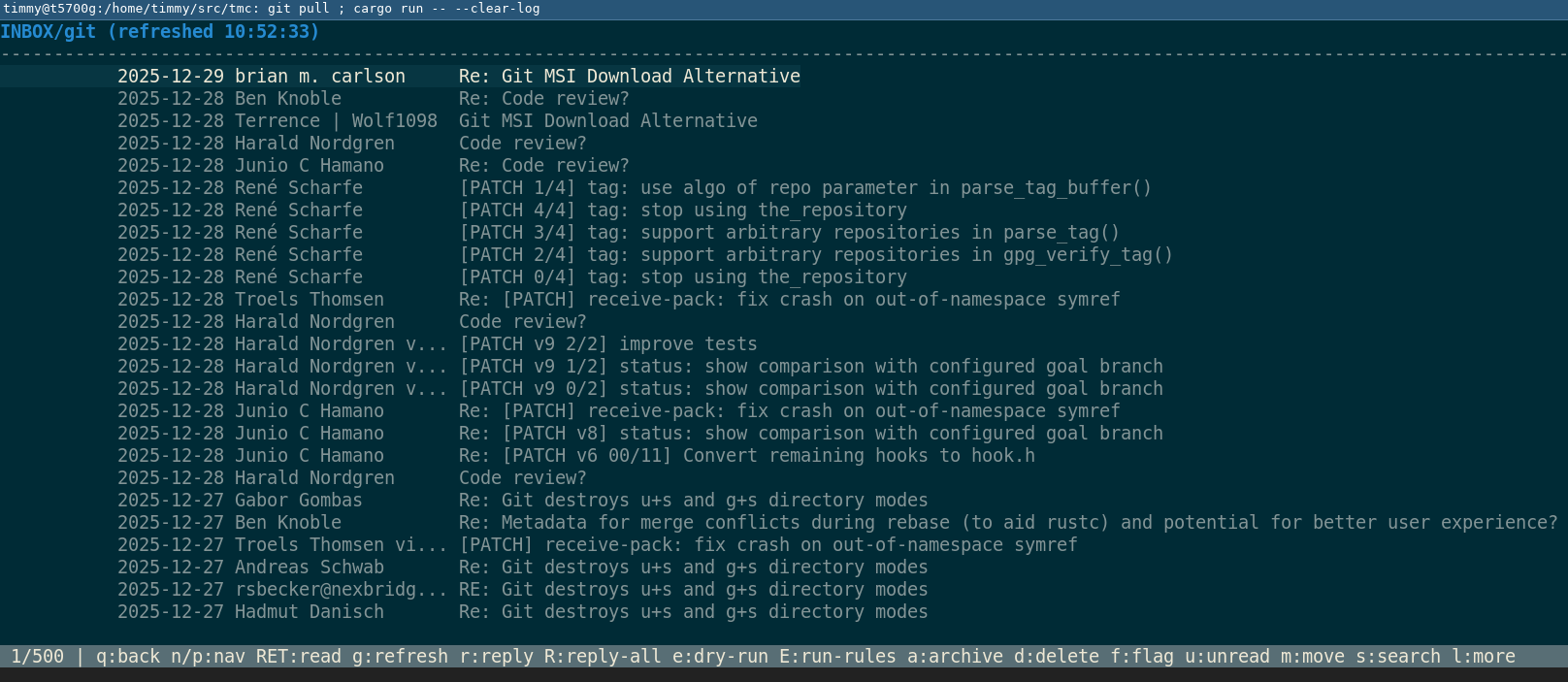
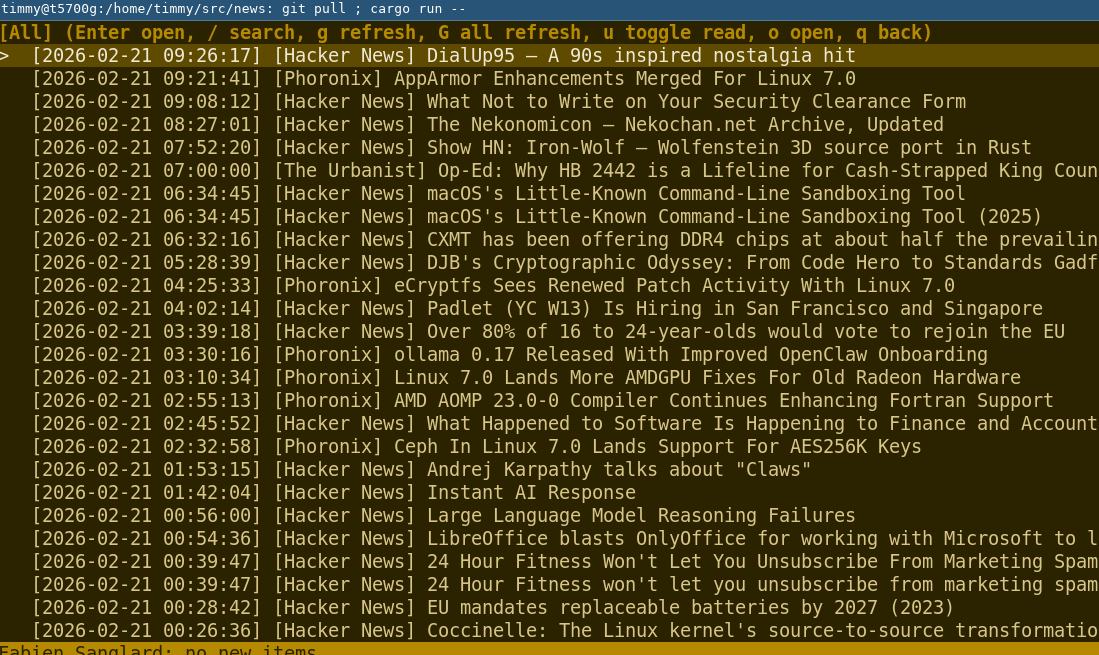
In my last post, I talked about using Claude Opus 4.6 and Codex 5.3 to create a TUI Rust email client. Later on that weekend, I went a step further and created a news client to replace the RSS to email solution I had previously. Now I have a dedicated TUI (called Timmy’s News) for reading RSS feeds. It’s pretty amazing to see how easy it was to create. While I have looked at the source diffs as they scrolled through the screen, I haven’t actually looked at the code. When I had questions about the architecture, I just asked the model to tell me.
There were some design decisions to make regarding how to synchronize the data store/cache with the online server. I also had it walk me through various options for storing data and what Rust libraries were available. In both cases, I went with redb for storage. News is easier because it’s read-only–you can have a process downloading to the news to a database, then the TUI just renders the database. With the email client, it was a little more complicated because you had to synchronize with the server and keep a consistent representation between the cache and the email server. Both Opus and Codex are at the point where they aren’t leaving the code in a broken state, getting lost, or introducing elementary bugs, which is pretty impressive.
Email client:
News client:
Historically you’d need to make software a little more complicated to have things like customizable key bindings, themes, configuration settings, etc. With this “bespoke software” approach, this can be hard-coded, and you just tell the agent to change the source when you want it to be different. I sort of wonder if we extrapolate this line of thinking, if programmable platforms like emacs and scripting languages will become less common because of the lower barriers around changing the application itself. Libraries still remain important, but the UI can be completely custom code.
Regarding Opus 4.6 vs Codex 5.3, I didn’t see much of a difference or much of a learning curve going from Opus to Codex. This project isn’t the best example to benchmark two state of the art coding agents at this point. I slightly prefer the TUI of Codex, in particular how scrolling feels ergonomic and lightweight, unlike Claude Code, which feels more like a game engine rendering a single screen. I have only come close once to the Codex usage limits (which apparently are under a 2x promo currently), but I was consistently hitting limits with Claude (which is what pushed me to pay for an OpenAI subscription).