I was thinking about doing another status update for my in-progress Linux distro, but instead I thought I’d do a post on another Linux distro.
I was watching the Lex interview with DHH and it seems like DHH is going on a media tour promoting his latest Omarchy linux distro. It was a great watch and if you haven’t been following AI-assisted software development recently, it’s a good summary of how that has changed things. The funny point they made is that you could have been backpacking offline for the last year and it’d only take you a couple of hours to get caught up on the latest practices because things have moved and become obsolete so fast.
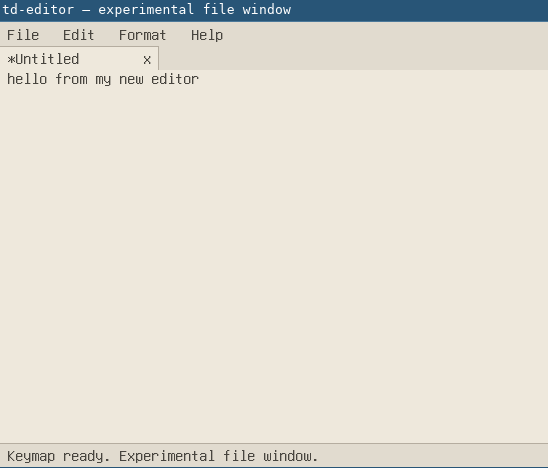
I felt like I had a similar story–after Opus 4.5 was released near the end of last year, I more-or-less stopped hand-writing code. Oftentimes I’d learn a new programming language by creating a text editor in that language, but now I barely using text editors anymore. I’m using emacs for writing these blog posts and composing email, but I recently started working on td-editor, the notepad-like editor that will be in my linux distro, and this might be the last blog post I write in emacs. It’s amazing how fast things have changed. Emacs has a long lineage back to extensions for the TECO text editor in 1976, and while it has up and downs over the years, it felt like it was in steady decline in more recent years due to the competition moving faster. This could have been a cyclical trend though, as I remember Lucid Emacs being a fork that tried to get GNU Emacs to move faster. While jwz’s post about it is an interesting read, I think the bigger change now is that there isn’t really a need for IDEs anymore in the age of AI agent-assisted development. Creating your own text editor is pretty easy for an agent to do from scratch. Here is td-editor, std-only Rust directly speaking wayland-protocol and doing its own font rendering, only a couple days with an AI agent:
Anyways, back to Omarchy. While I’d praise their work on the batteries included approach, the approach I’m taking with td is more like SerenityOS–a NIH project where we don’t have external dependencies. DHH tries to answer this on another podcast, but I feel like his answer misses the mark. Just because he can self host most of the packages on the AUR, doesn’t mean he’s looking hard at the packages that he’s serving. For example, you could look at the 12k LOC Cargo.lock file for the mise package manager the distro uses. That said, td is a distro for me and doesn’t need to support what most users are trying to do, while he’s trying to make something for everyone. I do think we’ll start to see a lot more NIH-like solutions where people create bespoke software instead of relying on external packages.